1.305.407.3778
take a risk

Take a Risk and Write a Song that is Different

“NOT ALL WHO WANDER ARE LOST.” (J.R.R. Tolkien)

You know you are a true songwriter and music producer when you go to work, out on the town, on a date or even when sleeping and all you can do is think about making music. The love of music includes networking, finishing your music and working on your music business, all which can be both mentally and physically draining when thinking about it ALL the time..

This can both be good and bad…

To most people around you, it may appear that you are extremely dedicated to your love but the reality is having music on your mind to that extent can reduce making music to just thinking about it. When I used to work a day job, I used to fantasize all day about playing my guitar – from when I got up to on the way home… Then when I got home I procrastinated and some days didn’t even play!

It’s so easy to spend all day planning and talking about music non-stop but never take action and write a song, pick up your instrument or make a beat.

Instead of doing your norm this weekend, do something you haven’t done before or something you haven’t done in a long time. Go for a walk, take a trip to a park you have never been and walk, or drive around town in an area you enjoy. Then watch your thoughts, watch your emotions, and watch your fears… Just pay attention, see what they’re doing… If the urge comes to write about them or if you have no desire to write but want to indulge the moment, so be it…

By stepping outside of the norm and doing something different, take a risk and write a song that is different, it will push different thoughts, different emotions, and give new inspiration to life and music… In turn this will start a whole new dialogue of songwriting ideas, melody ideas and new approaches to making music productions.

If there is anything we can help you with, setup a free training consultation below.

the fame drug

The Fame Drug; When Fame Addiction is a Block to Music Success

“Fame encourages us to believe that if it hasn’t happened yet, it won’t happen. Fame is not the same as success, and in our true souls we know that.  Fame, the desire to attain it, the desire to hold on to it, can produce the “How am I doing?” syndrome. This question is not “Is the work going well?” This question is, “How does it look to them?” Julia Cameron

Flip through a Rolling Stone magazine or watch the Grammy’s and you’ll soon discover the fame drug at work. It eats at the artist child within whispering, ‘You’re not good enough, your music sucks, you’ll never achieve music success.’ If you peruse these forms of entertainment you have to watch yourself and be careful with these destructive inner thoughts of fame addiction you might have. Be on guard. Always when you have a big project you’re working on or when starting a new music project, someone with more talent, more affluence and more fame will come across your path to try and discourage you. Be careful that you don’t compare your ‘newly hatched’ creative work with someone who has years of experience and a little fame under their belt. In other words, don’t compare your rough sketch drawing to a Van Gogh painting. Don’t compare your newly laced track to the latest Timbaland beat. Yes, it’s good to make sure your sounds are up to par and to study technique, but that’s not what I’m talking about. I’m talking about comparing yourself to those that are famous and doing it so much that you doubt yourself. If you’re a student or have been doing music for ten years, you have to allow yourself time to be ‘just OK’. You have to let yourself make mistakes, you must allow your inner artist room to grow without comparison or judgment.

When we wish for fame what we are really wanting is acknowledgment and love. We seek affirmation as artists, “Is my music really good? Do people understand me?” Many artists have achieved high levels of success without becoming famous. So if this is one of your goals: Become a famous musician. Than beware. Striving to become famous is the fame drug that can hurt you more than help you. Yes, of course being famous is good. But it should only be a by-product of first being true to yourself, and becoming amazing at what you do. Being able to create something new and fresh and innovative.  Wishing to attain fame only hinders this delicate process. How can you be true to yourself when you have one eye on your competition? How can you create something fresh when you’re worried about what people may think?

When on the fame drug, fame addiction sets in and you feel lost to it’s grip, discouragement leading to writer’s block then sets in. The best thing to do is go to your studio and create. Write a song, play with music production, sing, rap or write a song. Creativity for the pure love of art is the only thing that can snap you back to reality.

Music success is not fame. Music success is when you are doing what you love every day. Music success looks different on everyone – your success is not going to be another’s success. Every day make time to pat yourself on the back for staying focused, playing, practicing – reward yourself with every little step of progress. This is your personal music success.

Remember, 85% of people do not know how to stay focused and keep moving forward no matter what the obstacles in your path. You are among the 15% of successful musicians and music producers.

Tutorial: When Fame Addiction is a Block to Music Success
1) When listening, studying or watching other artists, identify the temptation to compare and stop the thinking patterns that follow. If possible, stop listening to others music the day or hours before working on your own music.
2) Go to your studio, turn everything on and just start. No matter what your mind tries to tell you, stick it out. Its like going to the gym. The first 15 minutes you fight with ‘why am I here, I can’t stand this, this is boring, etc’. But after 15 minutes it changes to ‘I forgot how much I love this, this feels great, so glad I stuck to it’. So it is the same with music. Just turn it on and keep going.
3) Read articles and books, watch movies and videos that encourage your goals and creativity – no matter how different they are from those around you. Make a note of info that discourages you or brings ‘comparison thoughts’. Being mindful of these things during a music project, song, deadlines, etc will help keep you creative and inspired.

If there is anything we can help you with, setup a free training consultation below.

overcoming perfectionism

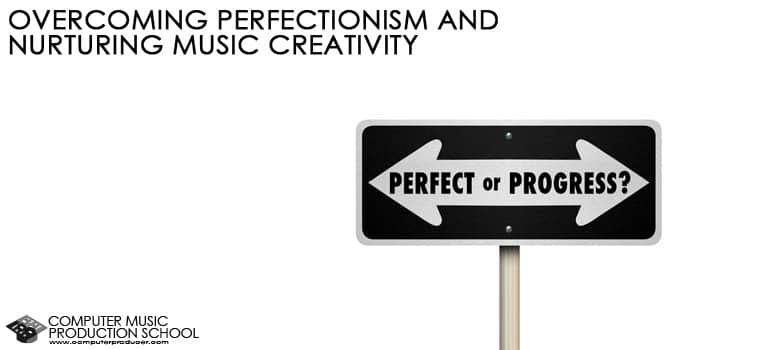
Overcoming Perfectionism and Nurturing Music Creativity

“The fear of doing things imperfectly turns what should be fun and creative endeavors into worrisome tasks.” -Chris Baty

Ah, the Inner Editor of perfectionism…we all have one. Some of us know how to keep this guy in a straight jacket but others seem to let him bounce around the walls of our studio, whining and complaining about every detail until he’s left us tired and uninspired. There’s a time and place to let your Inner Perfectionism have the reigns but when you’re first working on a production or creating new music it is not the time. As creative people we all have to learn the mental personality called the Inner Editor and choose to control him and use him what he’s made for: Editing.

If you are not editing but actually CREATING then the Inner Editing should be locked in your bathroom out of ear shot and not even a thought in your mind. If you have not mastered this, than it will take time. Like a heroin attack some of us love to over-use our Inner Editor any time, any place to critique and analyze our music and of course, others’ music. If this addiction is leaving you stuttering and drooling in front of your computer every night, than it’s time for rehab, my friend. Kick that Inner Editor to the curb and have some fun creating!

When you’re in the delicate stages of development you must resist the urge to edit vocals, doubt your melodies and second guess your sounds. You must keep in the flow and keep moving. Allow yourself to make mistakes and learn to use your mistakes to make your tracks sound more creative and funky. Resist perfectionism and spend only moments on each process of creating and recording. Keep your Inner Editor gagged and bound and watch how much your creativity will flourish and grow and pretty soon you’ll be keeping company with a whole other, more enticing, more satisfying friend: Mrs. Creativity..

Mrs. Creativity and the Inner Editor don’t get along too well. They actually fight like cats and dogs and need to be treated completely differently. Mrs. Creativity is a diva, a goddess that needs pampering, a safe environment and lots of loving compliments. She enjoys being splurged on, fun toys and gadgets and revels in spontaneity. The Inner Editor on the other hand, has a type A personality, loves perfectionism, a rigid schedule to keep, and a keen eye for detail. Keep these two vital characters in separate parts of your brain and learn to use them to your advantage. When Mrs. Creativity comes and sprinkles magic fairy dust on every thing she touches, she’ll wine and dine you till you’re giggling like a school girl. Let her have her way with no rules and no restrictions, allowing her to play. Once she leaves, allow the Inner Editor to come in and clean and tidy up her mess. This is where the Inner Editor flourishes! Allow him to tweak and edit, refine your sound choices and clean up messy lyrics. He’ll have a ball working with all of Mrs. Creativity’s gold-spun art.

As you can see, these two mental characters can work together beautifully if you allow them their own space and regulate their coming and going. Learn to acknowledge and respect each of their timings and you’ll reap the rewards with a more balanced and productive  approach to your music. Overcoming perfectionism and nurturing music creativity for the hobbyist,  students or child geniuses will bring out the giftedness and talent in any music production, making beats and recording.

Tutorial: Overcoming Perfectionism and Nurturing Music Creativity
1) Schedule time to create and stick to it. Discard all phone calls, emails or personal distractions (lock your door). Do the same with your mind.
2) When creating, do not listen to the inner critic giving advice on edits, arrangements, how things should sound or any thoughts that are not on the subject of your current creativity/project.
3) AFTER, your scheduled time of creativity, bring the technical critic, think of what others might say, then find references to compare and make objective decisions on the technical work. Remember, creativity is at its perfection when it is first allowed to breathe, edited and then this process loops until you are truly satisfied with your work.

If there is anything we can help you with, setup a free training consultation below.

Get Rid of Music Business Failure Once and for All

Get Rid of Music Business Failure Once and for All

“Love your experiments (as you would an ugly child). Exploit the liberty in casting your work as beautiful experiments, iterations, attempts, trials, and errors. Take the long view and allow yourself the fun of failure every day.” -Bruce Mau.

These are words of wisdom from the celebrated graphic designer, Bruce Mau. He knows the secret to keeping things creative and innovative while pushing the boundaries of change in his industry.

How do you view your creative and music business failures? Do you think of them as your own ‘ugly children’ and love them anyway or do you allow them to sabotage your creative flow? We all know this all too well but few acknowledge the fact that most insight and revelations come from failure not success. So count all the things you’ve been learning about music through your experiments of music production, recording, creating, mixing, mastering and let yourself have some fun!

Your music business can be as creative as your music. Keep that ‘F’ word in check and remember, we are to play music, not ‘work’ music – especially in music business. I know when you get serious about your message and art form, you tend to forget that. If your latest “hit” actually turned into a “flop” then you’ve discovered what you shouldn’t be doing and trust me, you’re that much closer to the pursuit of what you should be doing.

If there is anything we can help you with, setup a free training consultation below.